On the many shapes of entitlement and conflict
Well, friends, it’s happening again. I wondered if we would move past the intensity of ICE attacking our neighbors and our kin without offloading the pain of it on the people around us. I excitedly reflected in May and June and July and August that it seemed like we had avoided the intensity of pain offloading that happened in 2022 and 2023. Each time I wondered if we were gonna miss it this time, a voice in my head whispered: but Raffo, it’s still early. After the Uprising, it took a year or so for that rage to move from the State to the comrade.
Here in the Cities, it is rising just like elsewhere but I still fiercely maintain that it is not (yet?) rising to the level of four years ago. I want to believe that the horizontal breadth of care and consideration that showed up block by block is reminding us that we don’t get anywhere if we try to prune away everything that is uncomfortable until we are left, a stripped stem alone in a field, still rageful.
Conflict, like care, should be intimate. Relational. It isn’t relational nor intimate when it’s largely focused on internet attacks. Dear ones, you are spending energy that we don’t have, that we need. There is a reason for this. There are many reasons for this.
Over the last month, I have had a version of the same conversation with three different formations. These are groups of people who are birthing visionary work in communities carrying the weight of generations of attack as well as the glorious creativity of their aliveness. Each of those conversations has been with folks asking me questions about how you tend to those who join your groups and who are, as you soon realize, looking for a place to dump their pain more than they are looking for an accountable place of transformation and love.
In order to respond to those questions, I had to pull back and reflect for a moment on bodies. Bodies, bodies, bodies. Our bodies have a fairly standard array of mechanisms to communicate when something is happening. Pain, fever, inflammation, exhaustion, muscle tightness, changes in our digestion, changes in our heart rate or breathing, changes in our sleep patterns, and then all of those emotions. So many emotions. Each of these body expressions is nothing more than a sign asking for attention, a sign that can refer to thousands of different things. A fever can be a sign of an infection- from a bacteria or a virus or a parasite or a tick. It can be a sign of inflammation, a sign of heat exhaustion, a strong emotion being expressed, a hormonal shift, or a sign of cancer. It can be caused by a drug, both prescription and street, or a sign of hypothyroidism, a pulmonary embolism and more. Each of these origin points is completely different and needs different kinds of care, even though the communication is largely the same. A fever means our temperature has gone up and maybe there are chills or sweats or dry mouth at the same time, but the fever is the heat. A fever is a fever is a fever, even as what is behind it is yet to be discovered. We could create a similar kind of list for shoulder pain (rotator cuff or arthritis or something referred from your liver) or exhaustion (sleeplessness or Long COVID or menopause or a virus) or patterns with digestion (stress or anemia or food poisoning) and more. The symptom is the sign but what is behind it can be a constantly changing set of things.
The same is true with the emotions we show or don’t show, our behaviors and our facial expressions and the speed at which we move through a room and whether or not we make eye contact and how we perceive and respond to someone who is talking to us. There are only so many ways that a single person will interact with a room full of people - fast or slow, open and warm or closed and cold, joining or separating and so on. There are only so many ways a mammal can express itself but what is behind the expression seems almost infinite. This is one of the reasons why conflict work can be so hard. Rarely is any single thing about a single thing. We are layers. Always. We are a morass of generational inheritance, personal experiences, environmental contexts, cultural shaping, indigestion and constipation and reaction to the movie we saw yesterday. And every single aspect is always changing, always, all at once in a hundred different directions.
People-ing is hard. It is harder when there is no intimacy and relationship, no shared culture or meaning making. Hard does not mean impossible or dangerous, it just means hard. Hard can sometimes mean the thing that cracks you wide open to become even more of you than you were before. And so, in the midst of all of this complexity and constant change (thank you, Octavia Butler), we look for sign posts. Things to notice that will tell us how to respond.
This is why conflict gets the attention it gets. And it should. I often think that pain is to the individual body as conflict is to the collective body. It’s a sign that says something is going on. That we need to pay attention. And how we react to that sign is again about all of those layers that are constantly changing.
There is a reflection that I have shared verbally with folks, one on one and sometimes in small groups, that I haven’t really written about but I am going to write about now. It’s a tender thing, so ready to be weaponized and cause harm but also so much a part of what happens when we crash together. It’s a conversation about entitlement, something that the political movements I am part of use to mean one specific thing but which, just as a body’s fever, is actually an expression of something that can have a myriad of origins.
The concept of “entitlement” comes from Latin with “titled” meaning to give name to, an inscription or a heading. It was a word that emerged during the 13th century to mean the expansion of private property where a “title” is what you were given to prove you owned a piece of land. Think knights returning from the Crusades and being given land in exchange for serving the Catholic Empire. “Title” also referred to the way that social power was conveyed: you were not a person alone but you were a governor, a lord, a knight. To be “entitled” meant you have had these rights bestowed upon you: you were given a title by someone with the power to do so. The word “entitlement” then emerged, becoming a part of legal language, a way of referring to what you were owed as the heir of someone who had died, based on a social position, based on your job. The building of a public safety net between the 1920s and the 1970s emerged from the understanding that, as a worker whose labor created profits, you were “entitled” to a share of those profits in the form of health insurance, social security and other social benefits.
And because this is racial capitalism, organized around unequal systems of extraction, almost immediately, the concept of “entitlement” in this context was weaponized. In 1962, the year before I was born, the word “entitlement” started to have negative connotations, referring to someone having something they didn’t deserve. This came from a conservative attack on the welfare state by ironically calling benefits like welfare and public child support entitlement programs, a political manipulation to connote laziness. Ronald Reagan ran with this in the 1980s, using this concept to justify the privatization of direct services and other public programs that had been developed as part of the War on Poverty. In the 1990s, under the Clinton Administration’s attack on welfare, the concept of “entitlement cultures” emerged as a way of critiquing those who had been on welfare for more than one generation. The tricksy media story talked about benefits as getting in the way of supporting a strong work ethic, something used to target Black single mothers. Everything about this word’s history contains all of the movements over generations to keep one group of people having the wealth - the titles - while others are prevented from having anything extra. The minute that those who had been shat upon began to organize towards a more equitable distribution of resources, “entitlement” shifted from something tied to the Right of Kings to something dirty and shameful.
The history of this word is a history of a culture. Once your people have lived in this overculture for at least three generations, even if your people are also in resistance to it, the culture’s teachings start to creep in. Individual entitlement and all of the emotional trickery tied to this concept is in the air that we breathe. It’s part of what shapes the Global North and it affects many more of us than just those whose ancestral lands created these concepts.
We know what privileged entitlement is. It is when someone is raised in such a way that they believe that the world is there to organize itself around them. This is closest to the original meaning of the word. Privileged entitlement is when I believe I deserve ALL of the titles: all of the property and the attention and the decision making authority and the honor. Sometimes privileged entitlement is depressingly obvious and sometimes it is subtle as shit, so deeply embodied that it shows up in the micro-emotional movements as people shift in and out of relationship. Different shapes of it are raced and gendered differently but I see it in the movement spaces I am part of when folks assume they are entitled to someone’s attention or energy or relationship without having direct conversations about expectations and impact. It shows up when folks assume that the way that they think about an issue or a strategy is the only way to think about an issue or strategy and everyone else is only doing the right thing if they are thinking the same way that they are.
Within the context of Turtle Island, some of us are very entitled in this way and some of us less so or barely at all. Within the context of the planet, far more of us living in those places called the US and Canada (and western Europe and other Global North places) are privileged in comparison with other places, particularly in the Global South. The question is what we do with these privileges, how we hold awareness of their impact on those around us. There are plenty of kin on the Left who move into spaces from this place of privilege - racial, class, gendered, able-bodied, English-speaking, documented status, Global North born and raised, and so on - and who expect the rooms they are in to take care of them. To listen to them. Take care of their emotional responses, their visions and ideas, and their pain. When this is the entitlement that comes from privilege, this tends to be certain bodies who express this: white folks who assume they are entitled to feeling better in moments of conflict and that it is harm if they feel uncomfortable in the middle of disagreement and difference. Movement spaces know how to deal with this kind of privilege, the kind that comes from being raised to assume it is your invisible right to always have. Sometimes that person is asked to leave. Sometimes those with shared identities will pull the hyper-entitled person to the side and have a direct conversation, and so on.
But there is another kind of entitlement, this act of responding as though I or we have the right to have title to a thing, to name it, to own it, even if that contradicts what everyone else around us is saying. Remember what I said about fevers, this can look the same on the outside, have a similar impact to the collective body, even when the origin is completely different.
There is a kind of entitlement that can come from trauma or significant pain. This is what happens when someone has experienced significant harm, in their lifetime at the hands of a real person or as something passed down and that pain has festered, congealed, because there has not been enough space to heal and/or because the person has not realized they could get support and/or because the systems of violence have not stopped. People respond to this kind of pain in many many different ways but one of the shapes of response is something that, well, the only thing I know to call it is “entitlement.” Not because it is entitlement, but because that is what it resembles.
It’s what happens when someone acts like this: “fuck all of you, it’s my turn. I’m going to take what I want because I haven’t had it before! I deserve this shit because of all that I have been through.” This can show up in a room of people with shared identity and experience or a room that has different identities and experiences. This is what happens when the person demands that the group takes care of their emotions, centers their experience and follows their lead and will keep pushing until either they get what they need or the group is destroyed. This is a wound that says the only way I know I am safe is if everything is exactly as I need it, no contradictions, no complexity. It’s a traumatized brain moment that says you are either with me or against me and there is absolutely no nuance, no middle ground and no place for relationship unless you do exactly what I need you to do first.
When this shows up, we get confused. Our kin are not lying, they have a real case to build about how they and/or their people have been hurt. The origin of the pain is real and is significantly different from the origin of privileged entitlement. And these differences matter. Deeply. But for the group that is trying to come together around a strategy, a practice or a moment of repair, to deepen relationship or figure out how to care for each other, the impact can feel the same, just as a fever is always a heating up of the body even if the reason for the fever varies. Unlike the first group, the ones who are rooted in inherited and assumed privilege, this one is more confusing. People show up in solidarity with those who are deeply hurt for all kinds of reasons, because they care and want to do the right thing, because they are terrified of being called out, or because they are not completely sure what is going on. Sometimes with this kind of trauma entitlement, no matter how long the space is held or how much we attune to our beloved or how many people show up in solidarity, the one who was hurt keeps blowing shit up. And there is a trail of broken relationships and formations in their wake. This is what I mean when I talk about trauma entitlement, a concept that is not literally correct but helps me to understand this thing. Over these past weeks, I have been getting a lot of phone calls about exactly this. A lot of people are hurting and the only thing they know how to do is to fight with everyone until that fighting maybe please God helps them find peace, and meanwhile they are leaving so much wreckage behind. And so folks are calling me, asking about conflict support but as I listen to the details I think, no, this is not only conflict. Or conflict is the secondary layer but there is something else beneath it.
This is all so tender. Because sometimes there is a formation that is fucked up, that is classist or ableist or any number of real things. Sometimes there is a person who is actually an abuser hiding in the form of a caring human. Sometimes one person is truth-telling when everyone else is shrinking away and their voice cracks open something stuck so life can flow again. All of this asks for discernment. Not surveillance but the kind of thing that rises from connection. Relationship. Conflict like care should be intimate. And holding someone accountable should be the same.
There are a range of call outs floating up again. And discerning between a call out that is an offloading of someone’s hurt and a call out that is a last ditch attempt to warn people of abuse can be profoundly difficult. Most of what I am watching roll out, again and again, has nothing to do with real people. I want to find a way to reach through these bloody interwebs and sidle up to whoever is trashing someone who is real and complex and does not hold state or situational power to a degree where their decision making concretely destroys lives… hey, I want to say. Stop. Just stop it for a second. Scream with me, if that is what you need to do. Let me gather a group of strong people to circle around you so that you can push and push and PUSH, attacking boundaries and ghosts and the symbols of violent systems so that you can get some fucking space because without it, you are trying to make all of us carry this shit for you.
One of my friends snorts whenever I say this but real change is glacially slow. It is generational. It includes moments where grief interrupts strategy or where strategy we never expected shows up in the middle of grief. The work we do for short term gains is a form of harm reduction. Everything else is the kind of slow that means you take the time to find your way into a relationship that is strong enough to hold what comes next. It means you make a thousand mistakes and people have dramatically different experiences of something that is happening and build radically different stories and crash together and then spend weeks trying to untangle themselves and all of this makes us stronger, even as it hurts along the way.
A few years ago, I was listening to the podcast Where the Red Cedar Grows, six episodes on Ojibwe history in northern Minnesota. In one of the episodes, an elder was speaking of the signing of the White Pine Treaty, an 1837 treaty that ceded land in what is now western Wisconsin and parts of Eastern Minnesota. What I heard on this podcast then combined with something I had heard an elder say in another room and while I don’t assume to understand everything I heard, I can tell you that everything I heard deeply moved me. The part that hit my heart, brought me to my knees, was when I learned what happened when the community had to decide whether or not they would sign this treaty. There are so many details, because there always are, and so many timelines weaving together but for the sake of this story, there is also something simple. This particular time, a time within a span of multiple signed and broken treaties, the whole community gathered together, discussing and grieving over whether or not to sign. The whole community, children and elders and the ones who were supported to come in because their bodies were hurting, the whole community talked throughout the night and into the next morning until the decision was made. One of the elders I heard this story from described the feeling of it, the sun is rising and the light has that thin quality to it when it is first rising, and there in that space of being tired and feeling the start of a new day, at the end of so much pain and conversation and discussion, with some people blocking the decision for hours and with so much time spent trying to find a way through for everyone, after all of this, the community made the decision to sign. The way she shared this story included not only a conversation about the pros and cons of the arguments, but also the moments where grief welled up and prayer needed to take the place of discussion and pain was there and a facing what had already been lost and back and forth with the intolerable and staying in it until something had settled. Not a choice in the full meaning of choice, not a choice where the options were endless, but a choice that the community, together, settled on.
This story shaped me. Deeply. It shapes me still. I think about it when I am asked to come in to a formation where someone is showing up with their pain and their demands, with their survival strategies that whisper in their ear that the only way they will be safe is if everyone does exactly as they say. Anything less than this is intolerable. When they, in some way, believe that they are the only one who really understands a thing and who has to fight to ensure that righteousness prevails. I think about this as I watch formations focused on liberatory or transformative work act in constant contradiction to the values we seek to uphold for strangers we have never met. I think about how deeply the wound of entitlement, this violent brilliant offspring of the cult of ownership, is like a parasite to our pain, whispering to the parts of us that feel so deeply alone that this aloneness is a place of power. Of authority. And the only way we will survive is to protect it, even if it means destroying what is around us.
I am working on a book right now that organizes around the idea that conflict is a natural part of life. Of course it is. What we call conflict is nothing more than what happens when difference encounters difference and is unsettled until it finds relational balance. Or doesn’t and so it changes. Until about 10,000 years ago, all signs point to this being how our species engaged in conflict, a process of finding some kind of relational balance. Sometimes in a bloody way but most often through agreements and fucking and yelling at each other and sharing of resources and exchanging gifts and sometimes fighting and moving back and forth between communities and through all kinds of mechanisms to find relationship. If you believe the poetry of evolution, then when did we first begin as a species? Was it 16 billion years ago when there is evidence of early hominids, people who like us used tools, demonstrated imagination, showed empathy and consolation, cooed with their children, used signs and symbols for communication, and had medicine? Was it 2.5 million years ago when we began to migrate off the African continent, branching into five or six or maybe more versions of hominids and built houses to shelter us? Was it 500,000 years ago when there is the first evidence of two legged ones cooking food over fire and making abstract art? About 40,000 years ago us homo sapiens seem to have become the only two leggeds, minus Sasquatch and all of the others who might still be around, and still for another 30,000 of those years we seemed to find our way without engaging in large scale destruction. And then that shifted and 10,000 years ago, within the scale of our species mere seconds ago, conflict started to show signs of using force to have more than what we would have if we were still a part of the natural rhythm of life. Not all of us, the first evidence of warfare was found 10,000 years ago in what is now Kenya, but the capacity for conflict to take more, to seize outside of relationship, to claim that our way is THE way even if it means destroying you, other humans, those olive trees, that cypress..that started to spread from one land to the next, seemingly all at the same time. There is something to the fact that this scaled up conflict emerged at the same time as life was getting easier, that Holocene period when survival maybe didn’t take as much of our effort. So yes, conflict is a natural part of life, there has always been conflict, but what happens when we are no longer a natural part of life? What happens when we have been so shaped by individualism and the idea of ownership and private property, whether we are the ones whose people have owned or the ones whose people have been owned or sometimes both, that conflict always feels like a continuation of our capacity for war, where survival is not about connection but about different shapes of being the ones who win.
I keep thinking of that group of Ojibwe people staying alive together all night to try to decide something that is, on every level, intolerable. One of the parts of the story is that the people staying up all night were not folks who came from the same tribe. They were not people who had been living in community with each other already for generations. The reasons for this were about how the US government decides who is the leader and who it wants to work with rather than respecting sovereignty and so the US said you, over there, you are the people we will talk with about these pine forests, these stands of white pine that can live thousands of years, we entitle you to be the ones who decide… and so a group of Ojibwe people gathered together and what came out of this was relationship. Not with the US government but among the Ojibwe people in that room. I don’t want to romanticize it as is my people’s way and I don’t know enough to go more deeply than this but in her storytelling, what I heard from the elder who was speaking was a capacity to struggle together and to grieve in the face of something intolerable. I think about how everyone in the rooms I am facilitating are all people who also have many things in common, not everything but many things, who have the sovereignty to stop when things are tight and intense and maybe pray or sing or grieve but instead, most often, we explode or compete or collapse. Because we have been so shaped by the cultures of domination, of authoritarianism, that a whole bunch of us, even the ones who have been most hurt, carry a bit of that domination inside. This is the pain, this cultural wound of colonization, of the many things we call it but which all lead back to the same thing, a fierce and unyielding strategy to keep us separate. That to survive and be safe, we can’t be with you, we have to overcome you. Too many of us believe, either with our minds or with our emotions, that the opposite of separate is some kind of peaceful alignment, some kind of moment of total safety but often the opposite of being separate isn’t agreement but just companionship in very difficult times. Companionship without trying to fix everything right away because not all things can be fixed. And then discernment between what can actually destroy us and what just makes the air between us feel a bit spiky.
This is the conversation I have had a lot these recent months: it is not your responsibility to hold the sum total of another person’s pain, especially when you have had no responsibility for that pain. It is your responsibility to have boundaries but to hold them with tenderness. You can say things like: I can see that you are hurting and it wrenches at my heart to know this - but only say that if it is true. And then you can say: here is what I can do but I can’t do more than that and I know it is not all of what you want. I know that it is deeply unfair that you have been hurt and are suffering and here, this is the thing that I can do. This is what I can offer, along with my love and care and willingness to see what is here, even knowing that I can’t help you to completely change it.
For some of us, this is what is intolerable. Not only how someone’s pain tries to take over a room until the room is destroyed but also the truth that there might not be anything we can do to change it.
I remember somewhere around year 6 or 7 of my bodywork practice, I was talking with another practitioner. This was - and is - a woman who I am so grateful to call a mentor, someone whose wisdom about pain and relationships is always teaching me, a woman of color whose work on generational trauma and historical pain is still some of the most incisive and loving that I have yet come across. We were talking about a person we both know in community and someone who was an occasional client of mine. I had turned to my mentor for help in discerning what and how to meet this person, noticing how often I felt in thrall to the size of their need. My friend, my mentor, looked at me and said, Susan, you do know that not everyone heals, right? You know that not everyone is going to get better. And that no matter how much energy you pour into them, it is just going to pass right through their need and their need will not diminish?
When she said this, there was a strange kind of permission that flowed through me. A permission that even as I was feeling it, I paused and said to her, oooh, this could be dangerous. My people, meaning white Christian folk, have used this kind of thinking to justify eugenics and the essentializing of some people as dangerous and others as innocent and all kinds of other violences. We have used this truth to wash our hands of the pain we have caused and have used it to blame others for their hurt even when we were part of what caused it. Yes, she nodded, that’s true and not only your people do this, although yours have created this country’s version of it. And, she said, it is also true that some people will never heal. And because we won’t know who this is true for until we get to the other side of never, we can’t just keep giving everything we have when there is no evidence of change. Even, she said, when there is evidence. After all, that is how saviorism and missionaries emerged, from this idea that you can control people with the right kind of effort. This is not a pronouncement or a prophecy or a diagnosis, but it is a moment of humility. A moment that says, another person’s survival is not your responsibility even as care is something you can offer.
Conflict is a natural part of life, but too many of us are not a natural part of life anymore. So many social relationships have been broken or wounded or attacked or distorted or destroyed. Some conflicts can never be repaired and that is part of finding relational balance and some people’s wounds will not be healed or negotiated with and we have to find ways, good and right relationship ways that are accountable to more than our own thinking, to discern when we keep reaching and loving and ideating and tending and when we say, with grief in our hearts and rage at what generations of violence have created, this has to stop now. This has to end.
What is the opposite of entitlement? Maybe it is connection or care. Maybe it is sympathy or empathy, or maybe it is just humility, an old word that means of the earth. Close to the ground. Lowly. Together.
***
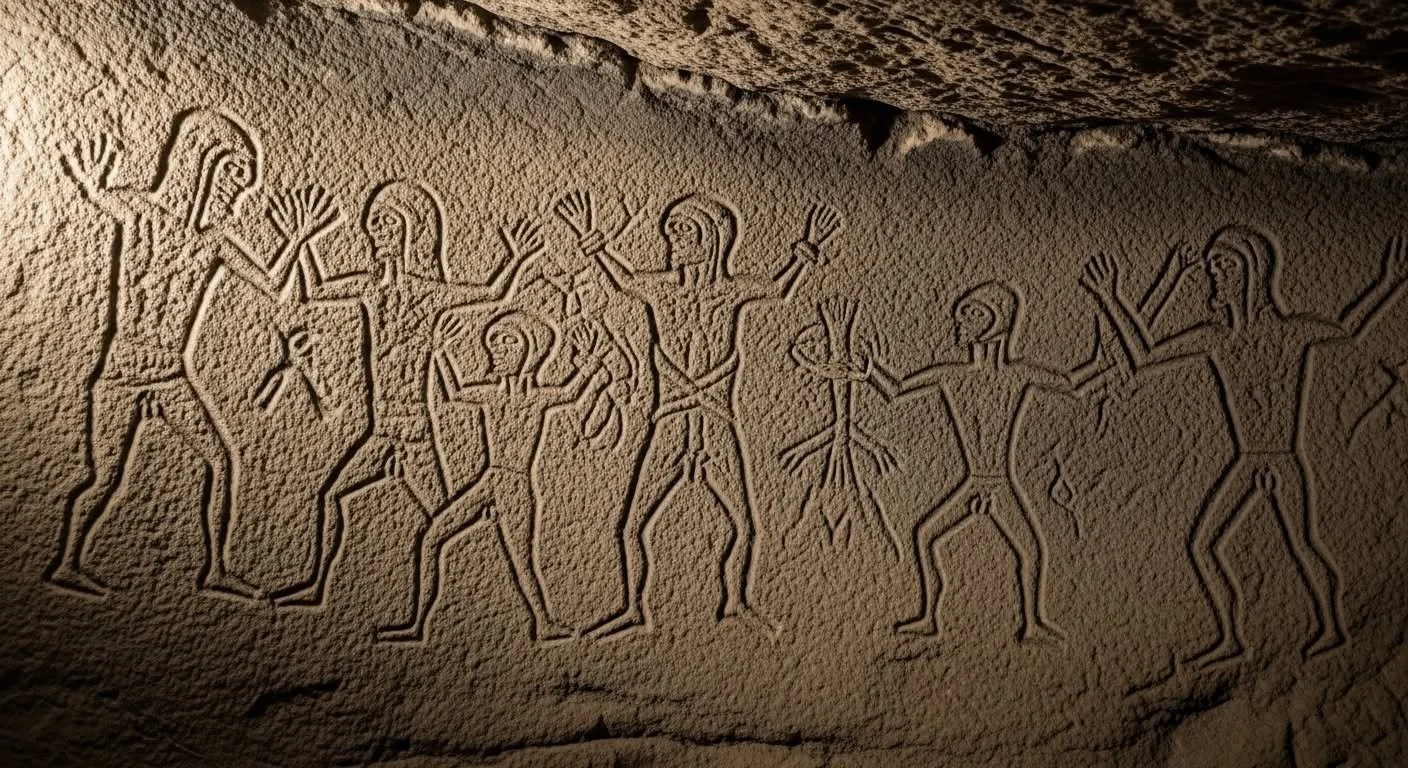
The image above is one of the oldest encountered depictions of people celebrating or engaging in ritual and it is from Sicily, found in the Addaura cave.
****
If you like what I write, please consider supporting me through Patreon. This kind of support is how I keep all of my writing as an offering and not something only available to subscribers. And writing like this is where I practice ideas and thoughtlines that then support work and action with real people in real time - and sometimes future books. Through Patreon, I occasionally chat with my patrons, either sharing thoughts, ideas or recently a poem; things not shared anywhere else. And whether or not you are able to join this Patreon, thank you for reading.